At the start of the German Year of
Mathematics, the Oberwolfach
research institute has released an exhibition and
the software they used to produce it. The software,
surfer, is a really nice GUI
that sits on top of surf and lets you
rotate and zoom your algebraic surfaces as well as pick colours very
comfortably.
They have a whole bunch of Really Pretty Images at the exhibition
website, and I warmly recommend a visit. If
you can get hold of the exhibition, they also have produced real models
- with a 3d-printer - of some of the snazzier surfaces, so that one
could have a REALLY close encounter with them.
But also, I'd really like to show you some of my own minor experiments
with the program.
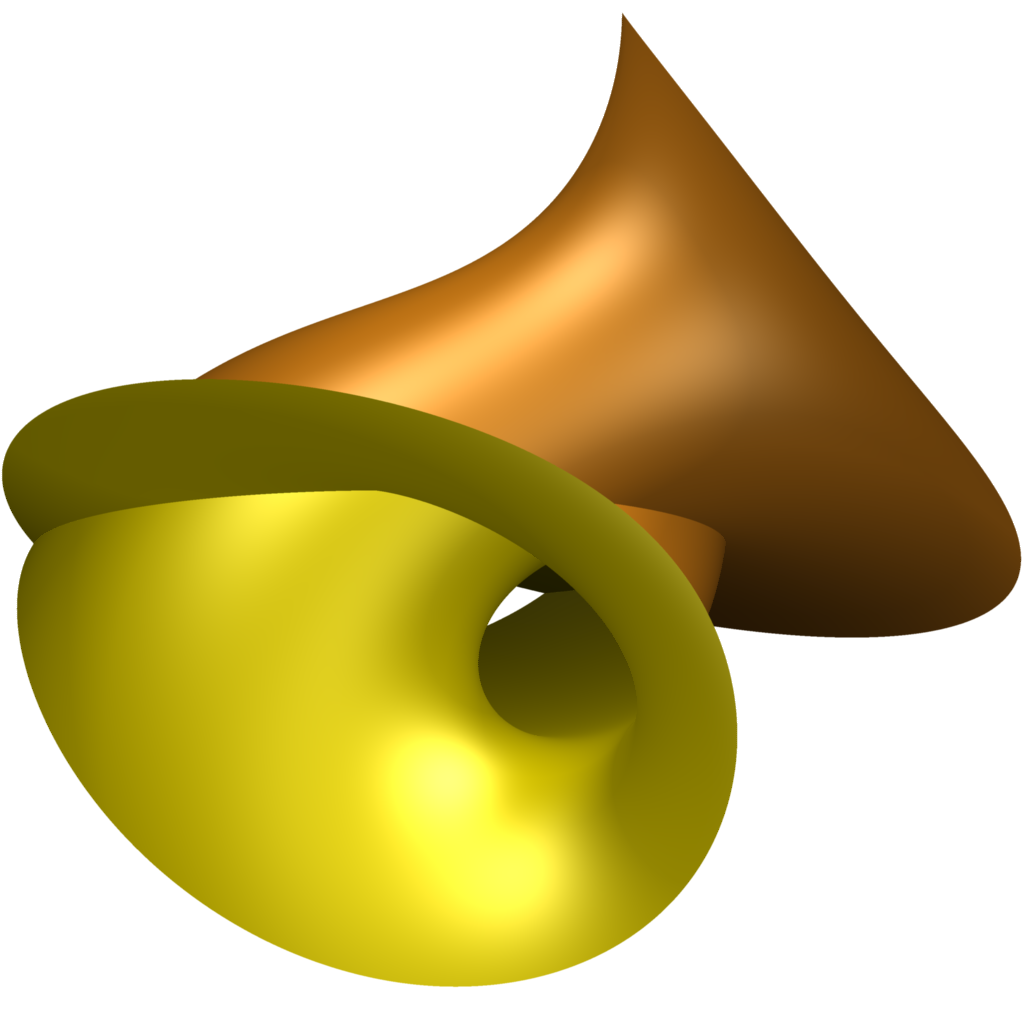
This is the interior of a Klein Bottle, using the "standard"
realization as an algebraic surface given by Mathworld. In other
words, I'm using
(x^2+y^2+z^2+2*y-1)*((x^2+y^2+z^2-2*y-1)^2-8*z^2)+16*x*z*(x^2+y^2+z^2-2*y-1)=0
for the defining equation. It kinda looks a bit like a Sousaphone in
my opinion.
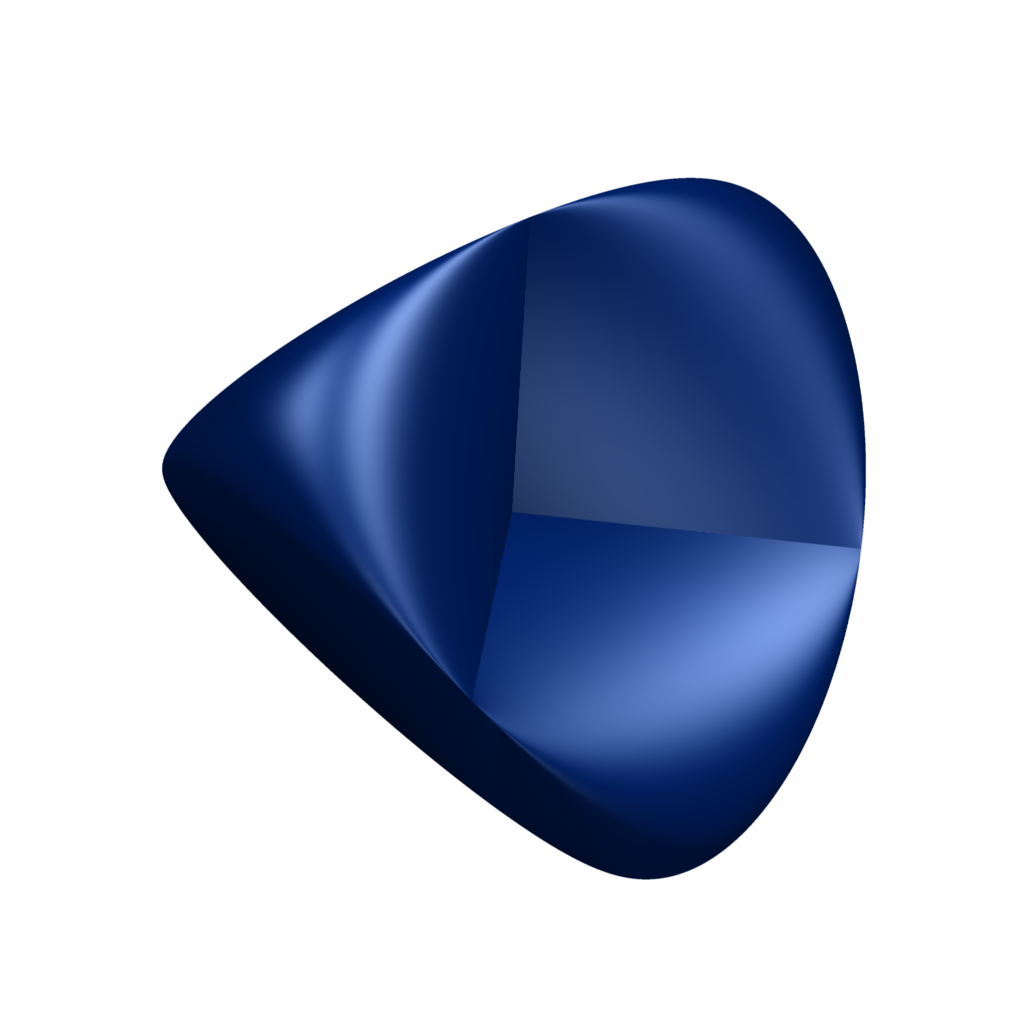
Roman's surface, an immersion of the real projective plane into
3-dimensional euclidean space. It is given by the equation
(x^2+y^2+z^2-9)^2-((z-3)^2-2*x^2)*((z+3)^2-2*y^2)=0
and is one of the Steiner projections of the Veronese surface,
embedding the real projective plane into projective 5-dimensional
space by the homogenous parametrization (x^2,y^2,z^2,xy,xz,yz).
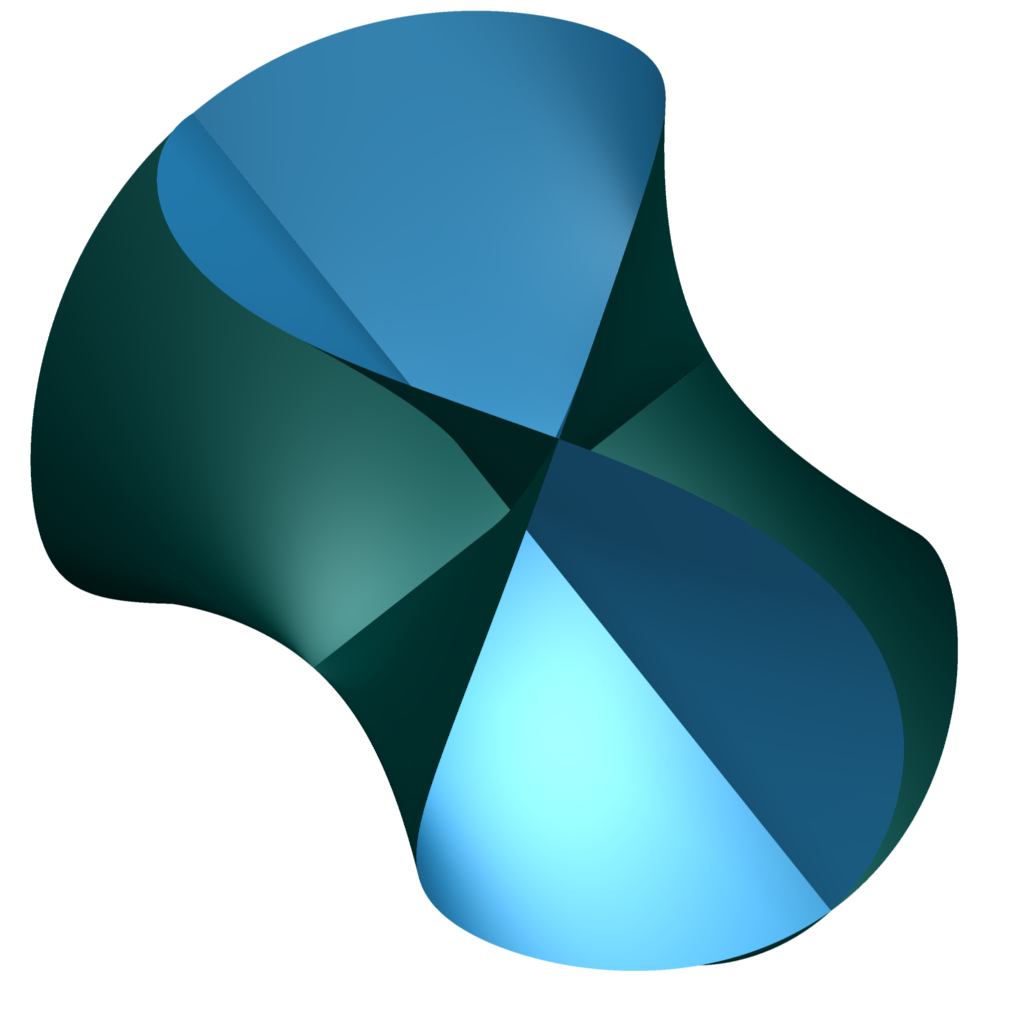
With the defining equation
x^2*y^2-x^2*z^2+y^2*z^2-x*y*z=0
this Steiner surface can be transformed into the Roman surface above
if (and only if) you're allowed to take shortcuts over the points at
infinity. As it is, it has two pinches (both visible) and three lines
of self-intersections (also all visible, kinda sorta). It's also
unbounded - one of the reasons that you cannot get to the bounded
Roman surface easily.
With this as inspiration - go forth and draw surfaces. And when you do,
please show them to me too.