Michi’s blog

Testing out the wplatex package

  • February 3rd, 2010

Eric Finster, over at Curious Reasoning has built a python script to allow you to write Wordpress posts entirely in LaTeX , and upload them. The script parses the LaTeX code and generates HTML that expresses the same structure.

This, here, is me trying it out. With any luck, the appearance of a new toy will get me back to actually blogging some more – it’s been winding down a bit much here lately.

Coordinatization with hom complexes

  • December 7th, 2009

These are notes from a talk given at the Stanford applied topology seminar by Gunnar Carlsson from 9 Oct 2009. The main function of this blog post is to get me an easily accessible point of access for the ideas in that talk.

Coordinatization

First off, a few words on what we mean by coordinatization: as in algebraic geometry, we say that a coordinate function is some X\to\mathbb R or possibly some X\to\mathbb C, with all the niceness properties we’d expect to see in the context we’re working.

A particularly good example is Principal Component Analysis which yields a split linear automorphism on the ambient space that maximizes spread of the data points in the initial coordinates.

Topological coordinatization

The core question we’re working with right now is this:
Given a space (point cloud) X, and a (persistent) view of H_*(X), can we use some map H_*(X)\to H_*(Y) to generate a map X\to Y inducing that map?

[MATH198] Lecture 10 (last lecture) posted

  • December 2nd, 2009

Now up: Lecture 10 with the definition of a topos and a derivation of internal, inutitionistic logic within a topos.

[MATH198] Lecture 9 posted and lectured

  • November 19th, 2009

Lecture 9: Catamorphisms, Anamorphisms, more from that zoo; adjunctions, some properties and some examples.

[MATH198] Multiple lectures posted

  • November 11th, 2009

I have been remiss in updating here. Since the last time I posted, I have posted:
Lecture 6, featuring some interesting limits and colimits, culminating in the introduction of adjoints.

Lecture 7, featuring the introduction of monads based in adjoints, with the connection between the monoid of endofunctors and the Haskellite specification of monads.

Lecture 8, featuring Eilenberg-Moore algebras, initial algebras for datatype specification, Lambek’s lemma and structural induction and recursion with endofunctor algebras.

[MATH198] Lecture 5 is up

  • October 23rd, 2009

And, as it turns out, my logic-fu is lacking. Next time around, it’s likely I talk about the CCC = typed λ-calculus correspondence, but won’t try to actually produce the correspondence explicitly.

[MATH 198] Lecture 4 and a question for the community

  • October 15th, 2009

Lecture 4 was held, and the notes are up on the wiki: Lecture 4 notes

During class, and in unrelated conversations afterwards, though, the question emerged:

If Formally differentiating datatypes gives us zippers? What happens if we formally integrate datatypes?

[MATH198] Third lecture is up

  • October 9th, 2009

The third lecture is up on the haskell wiki.

[MATH 198] Second lecture

  • October 5th, 2009

I’ve been maddeningly slow lately. With everything.

Since last week Wednesday, the second lecture is up on the Haskell wiki.

[MATH198] Lecture 1 now online

  • September 24th, 2009

The first lecture has been successfully held. The notes – which may well be augmented once I get hold of the students’ notes – are online on the Haskell Wiki

[Stanford] MATH 198: Category Theory and Functional Programming

  • August 29th, 2009

Category theory, with an origin in algebra and topology, has found use in recent decades for computer science and logic applications. Possibly most clearly, this is seen in the design of the programming language Haskell – where the categorical paradigm suffuses the language design, and gives rise to several of the language constructs, most prominently the Monad.

In this course, we will teach category theory from first principles with an eye towards its applications to and correspondences with Haskell and the theory of functional programming. We expect students to previously or currently be taking CS242 and to have some level of mathematical maturity. We also expect students to have had contact with linear algebra and discrete mathematics in order to follow the motivating examples behind the theory expounded.

Wednesdays at 4.15.

Online notes will appear successively on the Haskell wiki on http://haskell.org/haskellwiki/User:Michiexile/MATH198

Soliciting advice

  • July 22nd, 2009

Dear blogosphere,

come this fall, I shall be teaching. My first lecture course, ever.

The subject shall be on introducing Category Theory from the bottom up, in a manner digestible for Computer Science Undergraduates who have seen Haskell and been left wanting more from that contact.

And thus comes my question to you all: what would you like to see in such a course? Is there any advice you want to give me on how to make the course awesome?

The obvious bits are obvious. I shall have to discuss categories, functors, (co)products, (co)limits, monads, monoids, adjoints, natural transformations, the Curry-Howard isomorphism, the Hom-Tensor adjunction, categorical interpretation of data types. And all of it with explicit reference to how all these things influence Haskell, as well as plenty of mathematical examples.

But what ideas can you give me to make this greater than I’d make it on my own?

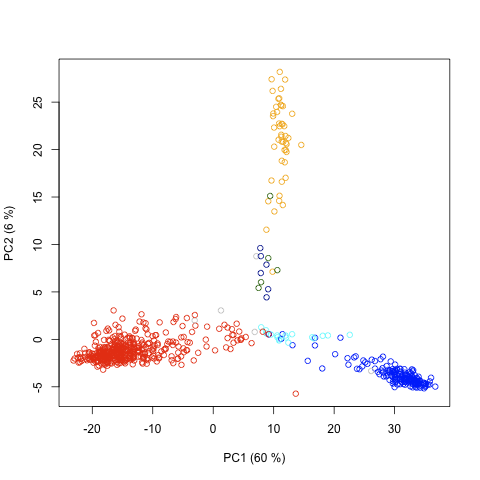
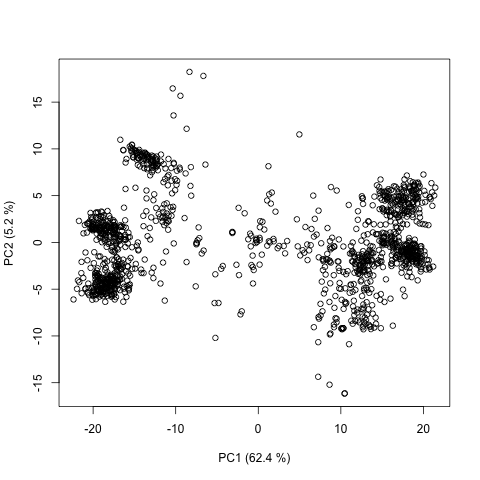
Guess the plots!

  • June 3rd, 2009

What do these depict?


Here are two others. Different data source, different point in time, but what are they?


They are all linked in pairs – one coloured and one black linked together. They are not sports related. And they are taken from real world data. The colours are relevant and constitute a hint in their own right.

Mapping zipcodes in R

  • May 13th, 2009

I started fiddling around with R again, and ended up playing with a zipcode database.

So, first I downloaded the zipcode database at Mapping Hacks, and unpacked the zipfile in my working directory.

Then, I loaded the data into R

> zips <- read.table("zipcode.csv",sep=",",quote="\"",header=TRUE)
> names(zips)
[1] "zip"       "city"      "state"     "latitude"  "longitude"
[6] "timezone"  "dst"      
 

So, now I have an R frame containing a lot of US cities, their geographical coordinates, and their zip codes. So we can start playing with the plot command! After rooting around a bit, I ended up settling on the smallest footprint plot dot I could make R produce, by setting the option pch=20 in the plot options. Hence, I ended up with a command basically like this:

Gröbner bases for operads – Or “What I did in my vacation”

  • May 8th, 2009

This post is to give you all a very swift and breakneck introduction to Gröbner bases; not trying to be a nice and soft introduction, but much more leading up to announcing the latest research output from me.

Recall how you would run the Gaussian algorithm on a matrix. You’d take the leftmost upmost non-zero entry, divide its row by its value, and then use that row to eliminate anything in the corresponding column.

Once we have the matrix on echelon form, we can then do lots of things with it. Importantly, we can use substitution using the leading terms to do equation system solving.

The starting point for the theory of Gröbner bases was that the same method could be used – with some modification – to produce something from a bunch of polynomials that ends up being as useful as a row-reduced echelon form.

1-manifolds and curves

  • May 2nd, 2009

I have been painfully remiss in keeping this blog up and running lately. I wholeheartedly blame the pretty intense travel schedule I’ve been on for the last month and a half.

To get back into the game, I start things off with a letter from a reader. Rodolfo Medina write:

Hallo, Michi:

surfing around in internet, looking for an answer to my question, I fell into
your web site.

I’m looking for an answer to the following question:

my intuitive idea is that a one-dimensional connected topological submanifold
of a topological space S should necessarily be the codomain of a curve (if we
define a curve to be a continuous map from an R interval into a topological
space).

Conversely, the codomain of an injective curve, defined in an open R interval,
should necessarily be a one-dimensional topological submanifold of S.

Applied knot theory

  • March 16th, 2009

Tech note: All figures herewithin are produced in SVG. If you cannot see them, I recommend you figure out how to view SVGs in your browser.

A few weeks ago, my friend radii was puzzling in his server hall. He asked if it was possible to prove that what he wanted to do was impossible, or if he had to remain with his gut feeling. I asked him, and got the following explanation:

He had two strands of something ropelike, both fixed at large furnishings at one end, and fixed in a fixed sized loop at the other. He wanted to take these, and link them fast to each other in this fashion:

I started thinking about the problem, and am now convinced I can prove the impossibility he asked for by basic techniques of knot theory. The argument is what I’ll fill this blog post about.

Picking fights over religion

  • February 4th, 2009

I suspect this will be a flame war magnet. On the other hand I feel compelled to write it.

First a bit of backstory. My wife enjoys, often and with engagement, discussing theology with her new friends. One of them, a pentecostal christian, gave her the book I don’t have enough faith to be an atheist by Norman Geisler and Frank Turek. I picked it up while visiting her, looking for some book to read, and have forced myself to read through most of it since.

The authors try to prove the correctness of Christianity over all other religious attitudes, but most importantly, prove that Christians are right and Atheists are wrong. And the way they do this is oftentimes insulting, very often ignorant of how to deal with the logical tools they try to use, and constantly reeking of a lack of objectivity in their purportedly objective exposition.

Homological Inclusion-Exclusion and the Mayer-Vietoris sequence

  • January 9th, 2009

This blogpost is inspired to a large part by comments made by Rob Ghrist, in connection to his talks on using the Euler characteristic integration theory to count targets detected by sensor networks.

He pointed out that the underlying principle inducing the rule
\chi(A\cup B) = \chi(A)+\chi(B)-\chi(A\cap B)
goes under many names, among those \emph{Inclusion-Exclusion}, favoured among computer scientists (and combinatoricists). He also pointed out that the origin of this principle is the Mayer-Vietoris long exact sequence
\cdots\to H_{n}(A\cap B)\to H_{n}(A)\oplus H_{n}(B)\to H_{n}(A\cup b)\to\cdots

In this blog post, I’d like to give more meat to this assertion as well as point out how the general principle of Inclusion-Exclusion for finite sets follows immediately from Mayer-Vietoris.

Inclusion-Exclusion, and the passage from two sets to many

The basic principle of Inclusion-Exclusion says that if we have two sets, A and B, then the following relationship of cardinalities holds:
|A\cup B| = |A| + |B| &#8211; |A\cap B

J, or how I learned to stop worrying and love the matrix

  • December 10th, 2008

Or actually, I haven’t quite yet.

But, out of a whim, I downloaded J and started to play with it while reading this set of neat notes on Functional Programming and J.

And … well … my reaction so far is kinda “Buh!? What the *** just happened there?”

The first example I ran across, tried to read, and finally managed to is the following:

+/ , 5 = q: >: i. 100
 

This snippet is supposed to tell us how many 0s are trailing 100!. To get at this, we first need to figure out what, exactly, is done here. First observation is that 100! is the product of all integers from 1 to 100. The second is that the number of 0s trailing this is the same as the lower of the orders of 2 and 5, respectively, dividing 100!. Which, in turn is the lower of the numbers of 2s and 5s occurring in the totality of all prime decompositions of all the integers from 1 to 100.

So that must mean I’ve been a mathematician since 2005?

  • December 8th, 2008

http://www.thesun.co.uk/sol/homepage/features/article2011061.ece

This is a rather atrocious article giving yet another ad hoc “formula” to compute some numeric measurement of something-or-other. In this particular case, it’s about cleavage, and how to avoid showing too much of it, but these “formulae” plague us every time some journalist wants to math up their reporting.

What caught my eye in this particular case was the people they lined up to back up the story.

Mathematician William Hartston, who holds an MA in Maths from Cambridge University, reckons this will save a lot of showbiz blushes on the red carpet.

“A girl can use this formula to see whether her outfit is counted as decent,” says William, author of Drunken Goldfish and Other Irrelevant Scientific Research.

So. He has a Masters in mathematics. Big whoop. Doesn’t seem to make him more able to distinguish nonsense when he sees it.

Site tweaks and travel plans

  • November 12th, 2008

I’ve tweaked the layout of my blog a little bit. Among the more notable additions to it is the little box with a list of the major travel plans in my future.

This box is connected to a Google Calendar, public, and maintained from my normal calendar program, in which I plan to announce travel dates for any major trips I make as they come up.

Note that currently stored in this calendar are:

  • Ypsilanti, MI, November 13-24 2008
  • Millersville University, Lancaster PA, December 10-19 2008
  • Christmas, Stockholm, Sweden, December 19 2008-January 4 2009
  • AMS MAA Joint Mathematics Meeting, Washington DC, January 4-9 2009
  • DARPA Topological Data Analysis, Santa Barbara CA, January 21-23 2009
  • AMS Southeastern Regional Meeting, Raleigh NC, April 4-5 2009
  • Operads thematic school, Luminy, France, April 20-25 2009
  • Operads international conference, Luminy, France, April 27-30 2009

More on Lichtenstein

  • October 28th, 2008

It turns out that there is even more to say on the communes of Lichtenstein.

First of all, there is a 5-clique in the communal graph, as Brian Hayes pointed out. But there are two different excluded subgraphs for planarity – so if we aren’t looking specifically for the chromatic number, but rather how this graph fails to be a “normal” land map, we might want to see whether it realizes BOTH.

It turns out that it does.

The following are two highlighted versions of the Liechtenstein communal graph.


The embedded K5 with edges in blue.


The embedded K33 with blue and red vertices.

On the chromatic number of Lichtenstein

  • October 28th, 2008

Following the featuring of the internal political structure of Lichtenstein on the Strange Maps blog, Brian Hayes asks for the chromatic number of Lichtenstein.

Rahul pointed out that I made errors in transferring the map to a graph. Specifically, I missed the borders Schellenberg-Eschen and Vaduz-Triesen. The post below changes accordingly.

Warning: This post DOES contain spoilers to Brian’s question. If you do want to investigate it yourself, you’ll need to stop reading now. Apologies to those on my planet feeds.

As a first step, we need to build a graph out of it. I labeled each region in turn with the exclaves numbered higher than the “main” region of each organizational unit. And then I build a .dot file to capture them all:

Cup products in simplicial cohomology

  • September 12th, 2008

This post is a walkthrough through a computation I just did – and one of the main reasons I post it is for you to find and tell me what I’ve done wrong. I have a nagging feeling that the cup product just plain doesn’t work the way I tried to make it work, and since I’m trying to understand cup products, I’d appreciate any help anyone has.

I’ve picked out the examples I have in order to have two spaces with the same Betti numbers, but with different cohomological ring structure.

Sphere with two handles

I choose a triangulation of the sphere with two handles given the boundary of a tetrahedron spanned by the nodes a,b,c,d and the edges be, ef, bf and cg, ch, gh spanning two triangles.

We get a cochain complex on the form
0 \to \mathbb{Z}^8 \to \mathbb{Z}^{12} \to \mathbb{Z}^4 \to 0
with the codifferential given as

\begin{pmatrix}
1 & -1 & 0 & 0 & 0 & 0 & 0 & 0\\
1 & 0 & -1 & 0 & 0 & 0 & 0 & 0\\
1 & 0 & 0 & -1 & 0 & 0 & 0 & 0\\
0 & 1 & -1 & 0 & 0 & 0 & 0 & 0\\
0 & 1 & 0 & -1 & 0 & 0 & 0 & 0\\
0 & 1 & 0 & 0 & -1 & 0 & 0 & 0\\
0 & 1 & 0 & 0 & 0 & -1 & 0 & 0\\
0 & 0 & 1 & -1 & 0 & 0 & 0 & 0\\
0 & 0 & 1 & 0 & 0 & 0 & -1 & 0\\
0 & 0 & 1 & 0 & 0 & 0 & 0 & -1\\
0 & 0 & 0 & 0 & 1 & -1 & 0 & 0\\
0 & 0 & 0 & 0 & 0 & 0 & 1 & -1\\
\end{pmatrix}
and

\begin{pmatrix}
1 & -1 & 0 & 1 & 0 & 0 & 0 & 0 & 0 & 0 & 0 & 0 \\
1 & 0 & -1 & 0 & 1 & 0 & 0 & 0 & 0 & 0 & 0 & 0 \\
0 & 1 & -1 & 0 & 0 & 0 & 0 & 1 & 0 & 0 & 0 & 0 \\
0 & 0 & 0 & 1 & -1 & 0 & 0 & 1 & 0 & 0 & 0 & 0 \\
\end{pmatrix}

R and topological data analysis

  • August 23rd, 2008

This is extremely early playing around. It touches on things I’m going to be working with in Stanford, but at this point, I’m not even up on toy level.

We’ll start by generating a dataset. Essentially, I’ll take the trefolium, sample points on the curve, and then perturb each point ever so slightly.

idx <- 1:2000
theta <- idx*2*pi/2000
a <- cos(3*theta)
x <- a*cos(theta)
y <- a*sin(theta)
xper <- rnorm(2000)
yper <- rnorm
xd <- x + xper/100
yd <- y + yper/100
cd <- cbind(xd,yd)
 

As a result, we get a dataset that looks like this:
Trifolium data

So, let’s pick a sample from the dataset. What I’d really want to do now would be to do the witness complex construction, but I haven’t figured enough out about how R ticks to do quite that. So we’ll pick a sample and then build the 1-skeleton of the Rips-Vietoris complex using Euclidean distance between points. This means, we’ll draw a graph on the dataset with an edge between two sample points whenever they are within ε from each other.

RIP Henri Cartan

  • August 22nd, 2008

As John Armstrong said, I didn’t know he was still alive!

On the algebraic topology mailing list, the announcement came today that Henri Cartan, once co-founder of Nicholas Bourbaki, died August 13, 2008:

La Société Mathématique de France (SMF) a la tristesse d’annoncer le décès d’Henri Cartan survenu le 13 août 2008 à Paris à l’age de 104 ans. Auteur d’une oeuvre scientifique considérable, membre fondateur du groupe Bourbaki, Henri Cartan a initié des générations de mathématiciens à la pensée mathématique, à son exposition et à son écriture. Président de la SMF en 1950, il a joué dès cette période un rôle de premier plan dans la vie mathématique mondiale. Européen de la première heure, il a fondé en 1957 l’Association européenne des enseignants et proposé dès lors la création d’un Livret Européen de l’Étudiant.
Militant des droits de l’homme, il a participé à la création du Comité des mathématiciens et oeuvré pour la libération de mathématiciens injustement emprisonnés à travers le monde.

The end of the line

  • August 4th, 2008

And a new beginning.

We seem to be a whole crowd finishing our PhDs all at the same time: pozorvlak, Gooseania and I. While my blog started as inspired by Gooseania, I won’t close it just because I’m done. I’ll continue blogging my Postdoc years, and hopefully all the way through my academic career.

Junior Mathematical Congress 2008

  • July 30th, 2008

Is one reason for my current inactivity. It seems to be shaping up to a REALLY GOOD event.

Blackbox computing of A-infinity algebras

  • July 25th, 2008

The last of my thesis results has reached article form. The paper Blackbox computation of A-infinity algebras has now hit the arXiv and been submitted to the Kadeishvili Festschrift issue of the Georgian Mathematics Journal.

Dr rer nat, Magna cum laude

  • July 17th, 2008

After about 5 semesters, one paper, one erratum (submitted to JHRS) and one thesis, and after taking two oral exams and delivering one 30 minute talk on my research, I am now (modulo the week or two it takes to produce my certificate) entitled to the title of doctor rerum naturalium.

Next stop is the topology in computer science workgroup at Stanford, where I have accepted an offer for a postdoc research position up to 3 years (conditional on my good behaviour :-) .

A vision for collaborative mathematics platforms

  • June 19th, 2008

Based on the extensive discussion at the Secret Blogging Seminar on tools for long-distance collaborations, Scott Morrison writes an introduction to source control with subversion for research collaborators.

In this post, Scott also offers, quite magnanimously, to setup and host subversion repositories for any mathematician who happens to want to start collaborating using subversion.

Which, to my mind, immediately prompts the question: why stop there? I’ve had ideas about setting up a free and easy to use platform for modern communication in the mathematical community before; but they were along the lines of duplicating wordpress.com’s efforts; which isn’t really something that pays off on your efforts. Reading this, though, raised a new idea.

Why not setup a server – preferably with a university data center as backing – which dispenses free platforms with the following contents:

  • Source control. Preferably option on subversion, git, mercurial – or some such selection of modern and wide-spread systems.

FRA-Lagen och falska positiver

  • June 18th, 2008

Jag har varit en god medborgare. Jag har börjat emaila politiker. Anledningen är gårdagens debatt och dagens återremittering av FRA-Lagen.

Kärnan i mitt email, efter en personaliserad inledning där jag återknyter till vardera riksdagsledamots insats i debatten, är följande argumentation.

Tanken med signalspaningen är att analysera trafikmönster, läsa innehåll,
och hitta allmänna mönster. Dock är inga av dessa metoder 100%
tillförlitliga, och det man vill hitta är väldigt ovanliga företeelser.

Problemen härvid är framför allt:
1) mönster är väldigt lätta att dölja. Det finns många och relativt
välkända metoder att bygga upp sina kommunikationer så att trafikanalys
blir i det närmaste värdelöst: man kan se till att alltid skicka massa
data åt alla möjliga håll, och därvid skicka mycket skräpdata, så att
när det väl skickas värdefull data så är det ingen skillnad i
trafikflödet.
2) kryptering är lätt att använda. Det finns många mjukvarupaket för att
kryptera all möjlig elektronisk kommunikation. Vi använder det för
bankärenden, för företagsintern kommunikation, och det är lätt att
använda för privata ändamål. Därigenom kan den som vill gömma sig
väldigt lätt göra all sin kommunikation oläsbar.
3) imperfekta metoder kommer dränka övervakaren i falska anklagelser.
Den internationellt kände säkerhetsexperten Bruce Schneier har
diskuterat det här fenomenet utförligt i sitt nyhetsbrev. En av de
bästa genomgångarna jag känner till finns här:
http://www.schneier.com/blog/archives/2006/03/data_mining_for.html

On purity and essence of mathematics

  • June 15th, 2008

I seem, lately, to be so densely planned that all I can do for my blog is to react on blog posts from Ben Webster at the Secret Blogging Seminar.

He has, recently, written a post inspired by the xkcd comic on purity in the sciences. The comic is funny, and rings true, but Ben brings up a severe criticism of the premises of the comic that rings back to my own years as a hotheaded undergraduate.

You should read all of Ben’s post, but if you don’t, you should at least read the following:

AMS and mathjobs.org are made of awesome

  • June 11th, 2008

I like the Mathjobs website that AMS are running. It’s a good source for math jobs, and seems to have just the right selection for me to get interesting stuff out of reading it.

Now, in a post just a day or two ago, Ben Webster of the Secret Blogging Seminar called for RSS feeds for the Mathjobs listings.

Imagine my surprise – and probably that of most the readers of the Secret Blogging seminar – to see, the day after posting, the following reply from Diane Boumenot at the AMS:

Hello all. First of all let me say, thank you for the kind words. Also, if you want to send suggestions to Mathjobs.Org, that can be easily done through the web site. However, thanks to Google Alerts and a willing programmer, your request has been received and acted on. As of this morning you can get an RSS feed through the View Jobs page of the Mathjobs website.

Restarting high school topology

  • May 21st, 2008

My two high-school kids came by today. We’ve been trying to get a new teaching session together since early February, but they had a hell of a time all through February, and all our appointments ended up canceled with little or no notice; and then I spent March and April on tour.

We pressed on with knot theory. Today, we discussed knot sums, prime knots, knot tabulation, behavior of the one invariant (n-colorability) we know so far under knot sums, Dowker codes, and we got started on Conway codes for knots. Next week, I plan for us to finish up talking about the Conway knot notation, get the connection between rational knots and continued fractions down pat, and start looking into new invariants.

Parallel and cluster computing with MPI4Py

  • May 18th, 2008

First off, I’d ask your pardon for the lull in postings – this spring has been insane. It has been very much fun – traveling the world, talking about my research and meeting people I only knew electronically – and also very intense.

To break the lull, I thought I’d try to pick up what I did last summer: parallel computing on clusters. It’s been a bit of blog chatter about SAGE and how SAGE suddenly has transformed from a Really Good Idea to something that starts to corner out most other systems in usability and flexibility.

Matlab? SciPy bundled with SAGE and the Python integration seems to be at least as good, if not better.
Maple? Mathematica? Maxima? Singular? GAP? SAGE interfaces with all those that it doesn’t emulate.

Tour dates

  • March 6th, 2008

Edited to add Galway

I’ll be doing a “US tour” in March / April. For the people who might be interested – here are my whereabouts, and my speaking engagements.

I’m booked at several different seminars to do the following:

Title: On the computation of A-infinity algebras and Ext-algebras
Abstract:

For a ring R, the Ext algebra Ext_R^*(k,k) carries rich information about the ring and its module category. The algebra Ext_R^*(k,k) is a finitely presented k-algebra for most nice enough rings. Computation of this ring is done by constructing a projective resolution P of k and either constructing the complex Hom(P_n,k) or equivalently constructing the complex Hom(P,P). By diligent choice of computational route, the computation can be framed as essentially computing the homology of the differential graded algebra Hom(P,P).

Being the homology of a dg-algebra, Ext_R^*(k,k) has an induced A-infinity structure. This structure, has been shown by Keller and by Lu-Palmieri-Wu-Zhang, can be used to reconstruct R from
Ext_R^{\leq 2}(k,k).

Introduction to Algebraic Geometry (3 in a series)

  • March 4th, 2008

I’m going to move on with the identification of geometric objects with functions from these objects down to a field soon enough, but I’d like to spend a little time nailing down the categorical language of this association. Basically, we have two functors I and V going back and forth between two categories. And the essential statement of the last post is that these two functors form an equivalence of categories.

Now, first off in this categorical language, I want to nail down exactly what the objects are. In the category \mathcal{AV}ar_k the objects are solution sets of systems of polynomial equations. And in the category \mathcal{RA}lg_k, the objects are finitely presented Noetherian reduced k-algebras.

The functor V:\mathcal{RA}lg_k\to \mathcal{AV}ar_k acts on objects by sending an algebra R to the solution set of the polynomial equations generating the ideal in a presentation of the algebra.

Introduction to Algebraic Geometry (2 in a series)

  • February 21st, 2008

I want to lead this sequence to the point where I am having trouble understanding algebraic geometry. Hence, I won’t take the usual course such an introduction would take, but rather set the stage reasonably quickly to make the transit to the more abstract themes clear.

But that’s all a few posts away. For now, recall that we recognized already that any variety is defined by an ideal, and that intersections and unions of varieties are given by sums and intersections or products of ideals.

This is the first page of what is known as the Algebra-Geometry dictionary. The dictionary is made complete by a pair of reasonably famous theorems. I won’t bother proving them – the proofs are a good chunk of any decent commutative algebra course – but I’ll quote the theorems and discuss why they matter.

Introduction to Algebraic Geometry (1 in a series)

  • February 21st, 2008

I’m growing embarrassed by my lack of understanding for the sheaf-theoretic approaches to algebraic (and differential) geometry. I’ve tried to deal with it several times before, and I’m currently reading up on Algebraic Geometry again to fill the void that the finished thesis, soon arriving travels and non-existent job application responses produce.

So, why not learn by teaching? It’s an approach that has been pretty darn good in the past. So I thought I’d write a sequence of posts on algebraic geometry, introducing what it’s supposed to be about and how the main viewpoints develop more or less naturally from the approaches taken.

Varieties

The basic objective of algebraic geometry is to study solution sets to systems of polynomial equations. That is, we take some set f_1,\dots,f_r of polynomials in some polynomial ring k[x_1,\dots,x_n] over some field k. And we write V(f_1,\dots,f_r) for the set of all simultaneous roots to all these polynomials:
V(f_1,\dots,f_r)=\{p\in k^n:f_1(p)=0, \dots, f_r(p)=0\}

Scripting Games in Haskell

  • February 21st, 2008

I saw the Cerebrate solve the first Scripting Games challenge: Pairing off. And immediately thought “I can do that in Haskell too”.

So, here it is.

import Data.List

cards = [(1,7),(0,5),(3,7),(2,7),(2,13)]

countpairs [] = 0
countpairs [a] = 0
countpairs (a:as) = length . filter (((snd a)==) . snd) $ as

pairingOff = sum . map countpairs . tails

And that’s that. Alas, the actual competition only takes Perl, VBScript and PowerShell, so I won’t be submitting this.

PROPs and patches

  • February 15th, 2008

Brent Yorgey wrote a post on using category theory to formalize patch theory. In the middle of it, he talks about the need to commute a patch to the end of a patch series, in order to apply a patch undoing it. He suggests a necessary condition to do this is that, given patches P and Q, we need to be able to find patches Q’ and P’ such that PQ=Q’P', and preferably such that Q’ and P’ capture some of the info in P and Q.

However, as such, this is not enough to solve the issue. For one thing, we can set Q’=P and P’=Q, and things are the way he asks for.

Now, I wonder whether we can solve this by using PROPs (or possibly di-operads or something like that). Let’s represent a document as a list of some sort of tokens. We’ll set D_n the set of all lists of length n, and we’ll set P_n^m to denote operations that take a list of length n and returns a list of length m.

Thesis written

  • February 15th, 2008

In a mean push, these last two weeks my advisor has read three different drafts of my thesis. And I’ve worked on getting the corrections in quickly. The last push started yesterday, when I got a bunch of corrections in the morning, had the last draft ready at 4pm, and then sat reading it myself until 1am.

My advisor took it home with him, spent the evening on it, and had his batch of corrections in the morning.

Hence, today at 10-ish when I got myself in to the office, I had two batches of corrections in front of me, and a printer closing at 2pm. So I worked – and now, well, it’s done.

That’s it.

It’ll get printed.

Then read.

In May, we should get all the comments back from the external examiners.

My topology students move into knot theory

  • February 1st, 2008

So, here’s the plan for my 10th grade topology students.

Today, we’ll abandon algebraic topology completely, and instead go into knot theory. I’ll want to discuss what we mean by a knot (embedding of S^1 in S^3), what we mean by a knot deformation (thus introducing isotopies while we’re at it) and the Reidemeister moves. Also we’ll discuss knot invariants – and their use analogous to topological invariants.

Later on, we’ll continue with other invariants; definitely including the Jones polynomial, and possibly even covering Khovanov homology. One possible end report would be to explain a bunch of knot invariants and show using examples how these have different coarseness.

Edited to add: I got myself some damn smart students. They figured out the Reidemeister moves on their own – as well as minimal crossing number in a projection being highly relevant – with basically no prompting from me. I’m impressed.

Algebraic surface toys!

  • January 25th, 2008

At the start of the German Year of Mathematics, the Oberwolfach research institute has released an exhibition and the software they used to produce it. The software, surfer, is a really nice GUI that sits on top of surf and lets you rotate and zoom your algebraic surfaces as well as pick colours very comfortably.

They have a whole bunch of Really Pretty Images at the exhibition website, and I warmly recommend a visit. If you can get hold of the exhibition, they also have produced real models – with a 3d-printer – of some of the snazzier surfaces, so that one could have a REALLY close encounter with them.

But also, I’d really like to show you some of my own minor experiments with the program.

Tuba Mirum - the innards of a Klein Bottle
This is the interior of a Klein Bottle, using the “standard” realization as an algebraic surface given by Mathworld. In other words, I’m using
(x^2+y^2+z^2+2*y-1)*((x^2+y^2+z^2-2*y-1)^2-8*z^2)+16*x*z*(x^2+y^2+z^2-2*y-1)=0
for the defining equation. It kinda looks a bit like a Sousaphone in my opinion.

Building my academic persona

  • January 18th, 2008

http://arxiv.org/abs/0707.1637
Just got accepted for publication in the Journal of Homotopy and Related Structures.

Damn, this feels good!

AMS-MAA JMM 2008 Liveblogging, day 4 – final day

  • January 10th, 2008

Today, the congress ended.

I bought one book – Adams’ Knot book, with free shipping, for $22.

And I drooled over one more – Kozlov’s Combinatorial Algebraic Topology. The hardcover was down from $99 to $70 at the congress stand, but still was WAY outside my own budget capabilities.

Now, this book does algebraic topology on simplicial complexes. It does everything I’ve wanted a reference for with simplicial complexes. And at some point, I’ll REALLY need to get it.

I listened to a bunch of talks on Mathematics and Arts – including one on knitting hyperbolic pant crotches for toddlers – and one on an analysis of a combinatorial game on graphs: “Flee from the Zombies” – very entertaining.

I also spent an hour talking about the historical background of A_\infty-algebras and bialgebras with one of Ron Umble’s students.

AMS-MAA JMM 2008 Liveblogging, day 3

  • January 9th, 2008

The day started bad. I overslept, went to the convention center, and realized that I had forgotten my badge. Back to the hotel, and then back to the convention center. By the time I got there, the first talk I wanted to hear – one on a generalization of Kuratowski’s theorem to simplicial complexes – was already over by the time I got there.

So instead, I learned beading. I did two prototype versions of small and neat little Borromean rings in golden seed beads and blue, shimmering bugle beads. The SF fan / knitter / crafter who taught me was busy doing earrings in the shape of torus knots. Gorgeous. She has a plan for doing triple torus knots (solid spirals with bugle – seed – bugle – seed – bugle – seed) interlinked like Borromean rings.

AMS-MAA JMM 2008 Liveblogging, day 2

  • January 8th, 2008

This was a packed day.

And yet, I had trouble finding anything in the talks I wanted to hear.

i woke up, went down to the employment schedule, and fetched my interview schedule. Then I went to Frank’s pancake house and ate their World Famous Apple Pancake. The thing was 20cm high, covered a full plate and incredibly delicious. It also cost more than I expected to spend on breakfasts, but splurging once is alright.

Then I walked around, doing nothing much, and checked out the universities I was assigned to interview with on the web. Small. Teaching oriented. And in small towns. Both of them.

First interview went well enough, though I doubt I’ll want to go there and I doubt they’ll want me either. I’m not convinced that a university whose main claim to desirability is their pre-veterinary and equestrian programs will agree with my severe horse allergy.

about
Michi is a recent PhD working in homological algebra and applied algebraic topology. This blog is his outlet for texts with some manner of thought put into them. Over at his LiveJournal intimate details and streams of consciousness might be found.
Not all here is mathematics. All here, though, are my personal thoughts and opinions. Please read the about page (linked above) for more details.
This blog uses statcounter.com for logging and traffic analysis. In order to identify return visitors, this site will issue a cookie on viewing the blog.
RSS Travel plans
Recent Comments
Tags
Categories
Blogroll
Family
Mathematician blogs
Archives
the rdc* theme